
Note: The following is a republished excerpt from P. & F. Corbin’s History of the House of P. & F. Corbin. Published in 1904, it recounts the companies’ history on it’s 50th anniversary. We have made no changes to this excerpt and what you see is exactly how it was printed in 1904, albeit in a different medium.
P. & F Corbin Partnership (1852-1854)
From January 1, 1852, until February 14, 1854, the business was a copartnership, carried on solely by the brothers, Philip and Frank Corbin. The line of goods received constant additions, increasing the labor of production and sale, and multiple the anxieties and burdens of the two partners. In 1853, Frank gave up his work in the factory and there after spent his time upon the road selling goods. Philip also made occasional trips in order to keep in closer contact with the market and its needs, and the assortment continued to grow under his direction, while a constantly increasing number of orders taxed the little factory to its fullest capacity.
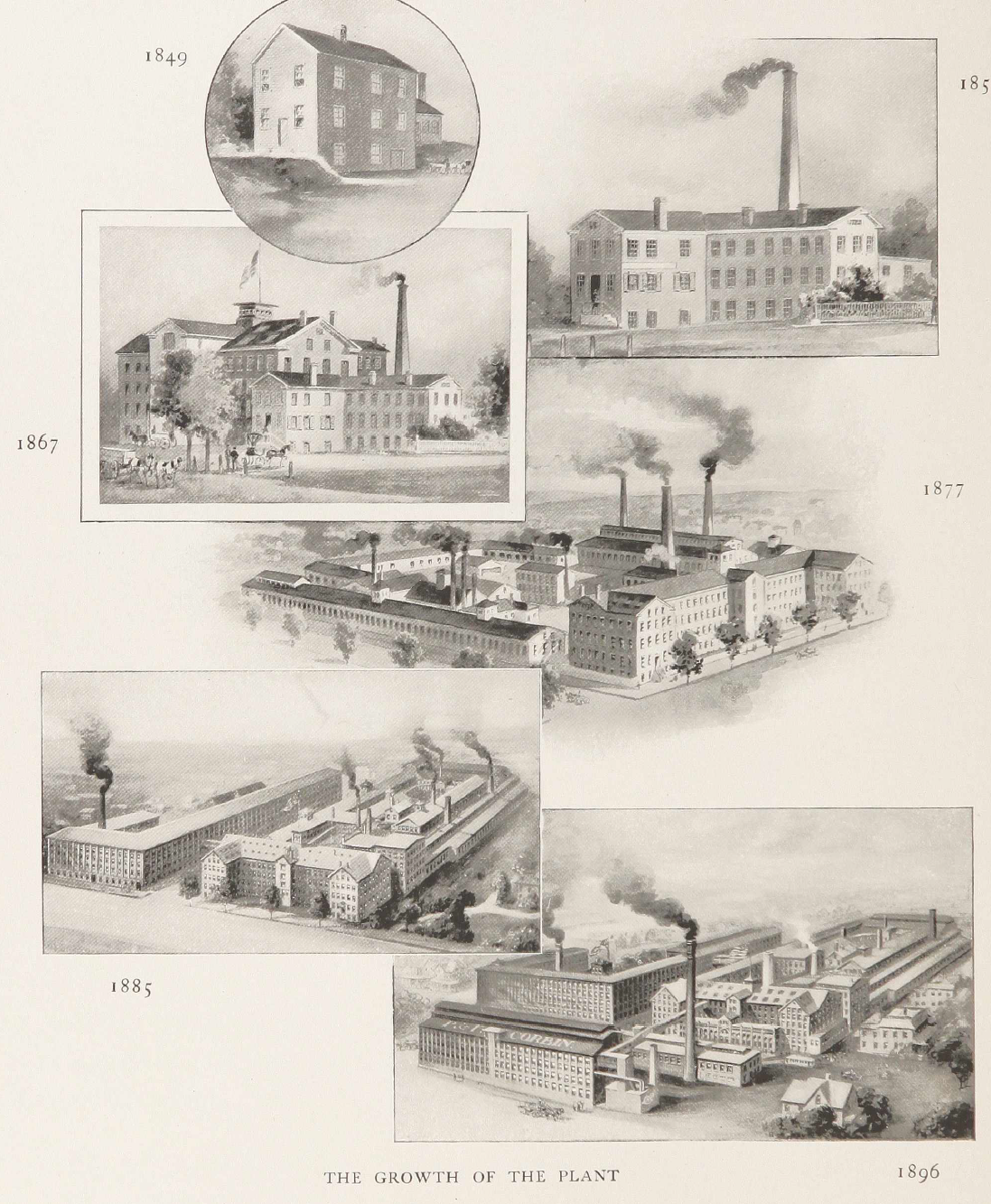
In 1852, the business had grown beyond the limits of the factory to care for it and a room was hired in the factory of North & Stanley on the site of the present west wing of the Corbin plant, where a number of lathes and emery wheels were installed and rub by power furnished by the owners of the building. At first, the goods were cast in the little foundry at the old plant, hauled to the new addition to be finished and taken back to be packed and shipped, but in a short time additional room was secured in the new premises, the foundry was moved up from the old site to the rear of the new location and the first factory was abandoned.
It will be of interest to know that the original factory building, built in 1847, still stands and serves a useful purpose. It was vacant for a short time after it was abandoned as a factory, and was then remodeled as a two-family dwelling and sold to two brothers in the Corbin employ. Later, these men decided to go back to their farms and Mr. Philip Corbin bought the building from them. It remained in his possession until a few years ago, when it was again sold and is occupied by two families. The first New Britain home of Mr. and Mrs. Philip Corbin, which was located with a stone’s throw of the first factory, also is still occupied.
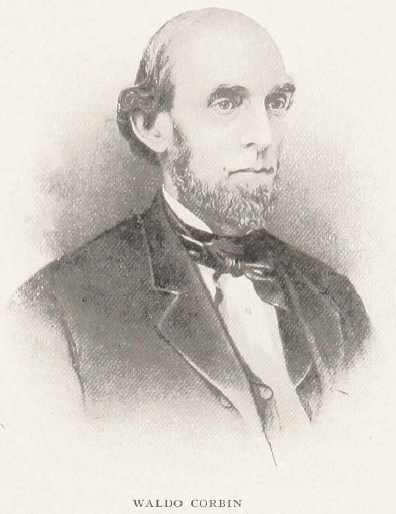
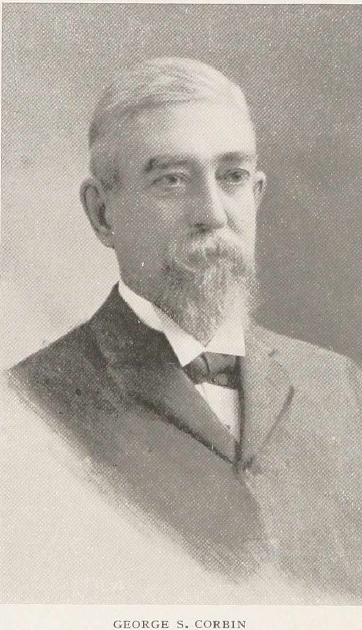 It was in this period that three more of the Corbin brothers became identified with the business. George S. Corbin, the youngest of the brothers, came into the shop as a boy, and was connected with P. & F. Corbin until his death. About the same time, Waldo Corbin joined his fortunes with his brothers, and in 1853, at the age of the 31 years, was made a partner. In 1853, Hezekiah, the oldest of the eight boys, also came into the factory, but soon left and afterwards embarked in the manufacture of paper boxes. There was plenty for everyone to do, and the rapidly-growing business taxes the powers of all to care for it.
 In 1852, Mr. Philip Corbin went upon a trip to Boston to introduce a new line of goods, neck bolts and barrel bolts, never before made in America. His sample case was two boards, with ends and side pieces and hinged at one edge to close, much after the fashion of the modern dress suit case. In this he had mounted samples of lifting handles, lamp hooks, brass bolts, and ox balls. He went into the establishment of Brooks Bros. on Dock Square, knowing that this firm dealt largely in these goods and hoping to secure their favor for his line. After some difficulty he found Mr. Brooks, who was standing on the ledge storing away goods on the shelves, and opened the case for his inspection, but after looking at them over his shoulder from his elevated position, and leaning that they were made by the salesman who presented them, Mr. Books not only declined to give them closer inspection but announced that as he imported such goods in large quantities he did not want the home-made articles sold in that market – adding that he would send for Mr. Corbin when he wanted to see him.
Several years later, Mr. Corbin was again in Boston upon similar errand, carrying an assortment of samples which had grown until a trunk was required to contain them and a wagon to transport them. While he was in M. C. Warren & Co.’s store, one of Brook Bros.’ clerks approached him and asked him why he did not call upon Mr. Brooks.
“The last time I did so,” replied Mr. Corbin, “he told me that when he wanted to see me again he would send for me. He has not sent for me yet.”
In a few minutes the man returned with a request from Mr. Brooks for Mr. Corbin to call and bring his samples. This he did, and trade relations were established that lasted during Brooks Bros. existence.
It was only natural that the importers should dislike to see their business encroached upon by the goods of domestic manufacture, for so long as the goods sold were of foreign manufacture they stood to trade in the same relation as the domestic manufacturer does to-day. There was a fear that if goods were made at home there would be no room in the trade for the large jobber or middleman, and the case of Brooks Bros. was duplicated more than once or twice in the early experience of P. & F. Corbin. Still the goods were lower in price, were better made and in many instances showed decided improvements, and thus they made their way rapidly against foreign competition and the very limited competition at home.
It became evident to the Corbin brothers that there was a much larger field than they could cover with their limited means and facilities, and that something to give a greater scope to their business should be done. At about this time one of the local manufacturers, who had learned to respect the capacity of P. & F. Corbin for the production of goods, proposed that the two concerns consolidate. When it was learned that P. & F. Corbin’s identity would be lost in the proposed consolidation that the proposition was not entertained, and another way was sough to secure the desired end.