
Note: The following is a republished excerpt from P. & F. Corbin’s History of the House of P. & F. Corbin. Published in 1904, it recounts the companies’ history on it’s 50th anniversary. We have made no changes to this excerpt and what you see is exactly how it was printed in 1904, albeit in a different medium.
Corbin, Whiting & Company (1849-1851)
The first traveling salesman for the concern was Mr. Henry W. Whiting, the new partner, who had previously done some work of this kind for Doen, Corbin & Co. and made three or four trips during his connection with the firm.
In the early years of this business goods were sold upon long time. The custom was to make settlement twice a year – in January and July – accepting in payment of accounts notes payable in four months. Customers would naturally defer making purchases until after the settlement period and then buy heavily, and the result was that on a large share of the goods almost a year’s time would be given. To hasten payment, manufacturers were wont to allow a cash discount of five per cent. at settlement time, or one per cent. per month for later prepayment of the notes. There was but little money in circulation, and a quick return upon capital such as is demanded to-day was not possible. This made it correspondingly hard for a new concern with limited means to make rapid headway.
In addition, American goods were not always looked upon with favor. The domestic manufacture of hardware was in its infancy, the known brands and favored goods coming from aboard. Importers and dealers, with their shelves stocked with foreign goods for which a trade was already created, were not disposed to buy domestic wares of no general repute which would have to be sold as substitutes for the well-known importations. To make articles already manufactured in this country would be but to add to the discomfort in introducing his line, so Philip Corbin decided at the very beginning to, so far as possible, make goods not then made in America, and thus eliminate one source of competition.
At the beginning, ox balls were the principal source of revenue, but other articles were added as fast as possible. The rule of avoiding domestic competition was very generally followed. Among other things, Corbin, Whiting & Co. were the first to make lifting handles with bails or drop handles. At this time these were imported freely and were largely used as coffin handles as well as for the regular uses to which such goods are now put. Mr. Corbin made improved jigs and tools to hold unfinished goods in process of manufacture and had the cost reduced to a figure which enabled him to undersell the foreign goods and make an attractive profit.
This coming to the ears of another firm of hardware manufacturers in the town, they determined to take up the same line, and one morning it was found that one of Corbin, Whiting & Co.’s workmen had gone, taking with him all data necessary for the production of the goods on the same basis. In order to forestall their coming competitors the price was materially reduced and large orders were taken, which filled the dealers’ stocks for some time to come. When the other firm was ready to market the goods, the price was again cut, and the new competitors found to their disgust that the promised large profit in the goods did not exist. Later, the price was restored, but the rival’s opinion of Corbin, Whiting & Co.’s ability to figure the cost of their product was decidedly an unfavorable one.
Corbin, Whiting & Co. bought their casting copper from a Mr. Brainard of Hartford. At that time the use of ignot copper for casing was unknown here, the greatest source of supply being the old sheathing of vessels. The metal account at times ran for some time, as all accounts generally did, and one day, when the indebtedness had grown to about sixteen hundred dollars, Mr. Brainard appeared at the factory and asked for Philip Corbin, who confronted him with paper cap on, sleeves rolled up and covered with the grim of the little brass foundry. To him Mr. Brainard explained his errand, and was given customers’ notes, not only to cover the indebtedness but to pay for more copper which would be needed soon. he left with the firm conviction that Corbin, Whiting & Co. were destined to grow and prosper, although it was made known in the course of his conversation that he had been influenced to call by the report of the rival manufacturers of lifting handles who were sure that Corbin, Whiting & Co. were not making money.
A half century ago there was much of the old Puritan spirit in Connecticut, the land of the Blue Laws and of steady habits. There was much of intolerance in matters of religion, politics, society, and business, born of the sturdy, combative New England character which has wrested prosperity and wealth from a sterile land in an unfriendly climate. The new firm had its way to make against the unfriendly feeling that the presence of a possible competitor aroused. That it did not fail at this stage of its career is due to the persistence and industry of its members, the favor which the unusual excellence of its wares gained with the large dealers, and the tact and skill and rigid economy that kept the business always upon a safe basis and made failure impossible.
In the fall of 1851, Mr. Whiting sold his interest in the business to the two brothers and on January 1, 1852, retired, the style of the firm being changed to P. & F. Corbin, as it has since remained. It is worth of note that Mr Whiting’s reason for desiring to sell was his belief that the line was growing too rapidly – that too many new goods were being added instead of all the productive energy being devoted to the manufacture and sale of those already adopted. Thus the first partner left because in his opinion the Corbin policy was not progressive enough, and his successor because it was too progressive. But the same steady, consistent, conservatively-aggress plan of action that marked the safe middle course and held to it in spite of all obstacles, that created a dollar and ten centers before it spent a dollar, governed the acts of the little concern and has perpetuated its existence.
It is also worth of mention that the particular thing to which Mr. Whiting objected, and which led to his withdrawal, was the the introduction of a line of thread escutcheons in which there was a good margin of profit and of which a full assortment from 3/8 to 3/4 inch was made. This still forms a part of the Corbin line.
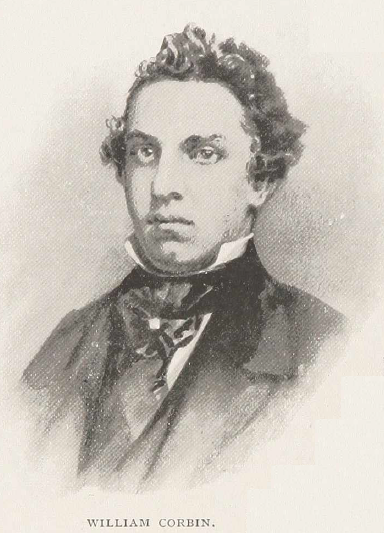
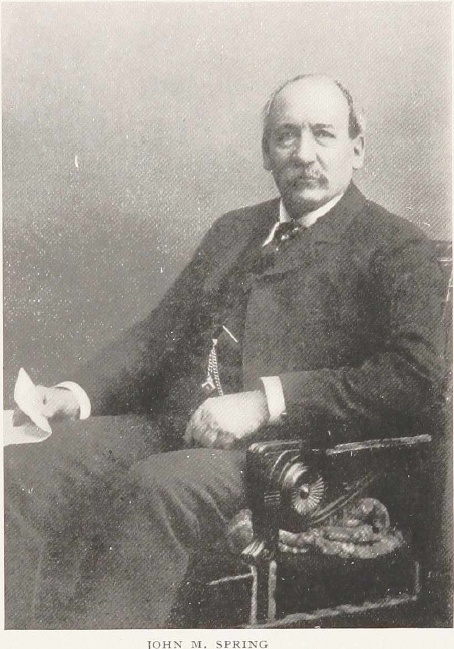 At the end of this period the force had grown to six or seven men. In 1850, William Corbin entered the factory as an apprentice and made signal progress in learning the business. In 1851, John M. Spring, who was destined to play an important part in the development of the industry, first entered the factory.
The concern was rapidly gaining recognition, because of the favor with which its products were received. One of the New Britain hardware manufacturers, who was acquainted with the quality of the goods, called upon the Corbins in the latter part of 1850, with friendly intent, and suggested they try to make an arrangement whereby another and large new Britain hardware manufacturing house would market the Corbin product and thus save selling expenses. The advice was not received with favor, as it was thought unwise to give outsiders control of the product, since they could at any time add the same goods to their own line and leave Corbin, Whiting & Co. without a market. Their wisdom in thus keeping free from an entangling alliance was shown a few years later when their friendly advisor, who marketed his goods through this third concern, found himself without a trade connection and with his old associates aggressive competitors with a duplicate of his line line made in their own factory.
In addition to ox balls and the lifting handles, of which mention has been made, their little catalogue issued by P. & F. Corbin in January of 1852 contains flush bolts, lamp hooks, buttons on plates, turn and trunk buttons, cupboard hooks, hat and coat hooks, hat hooks, trunk catches, spiral window springs, thread escutcheons, paste jaggers, stair-rod eyes, shutter screws, and table fasteners. In addition to the goods of their own manufacture, they bought and sold a number of styles of bolts made by Frederick T. Stanley.
Some of the goods then made are still incorporated in the Corbin line, and are standard in the trade to-day. Others have been dropped, the demand having ceased – such articles as lamp hooks for screwing into the ceiling and holding kerosene lamps suspended from wires; paste jaggers, which are now foreign to the line of goods made; picture hooks, which have been replaced by molding hooks; stair-rod eyes, which have made way for improve devices; and table catches for the old style drop-leaf table. Ox balls are still listed, principally for old association’s sake, and should be held in grateful memory for the important part they played in the earliest days of the business.