
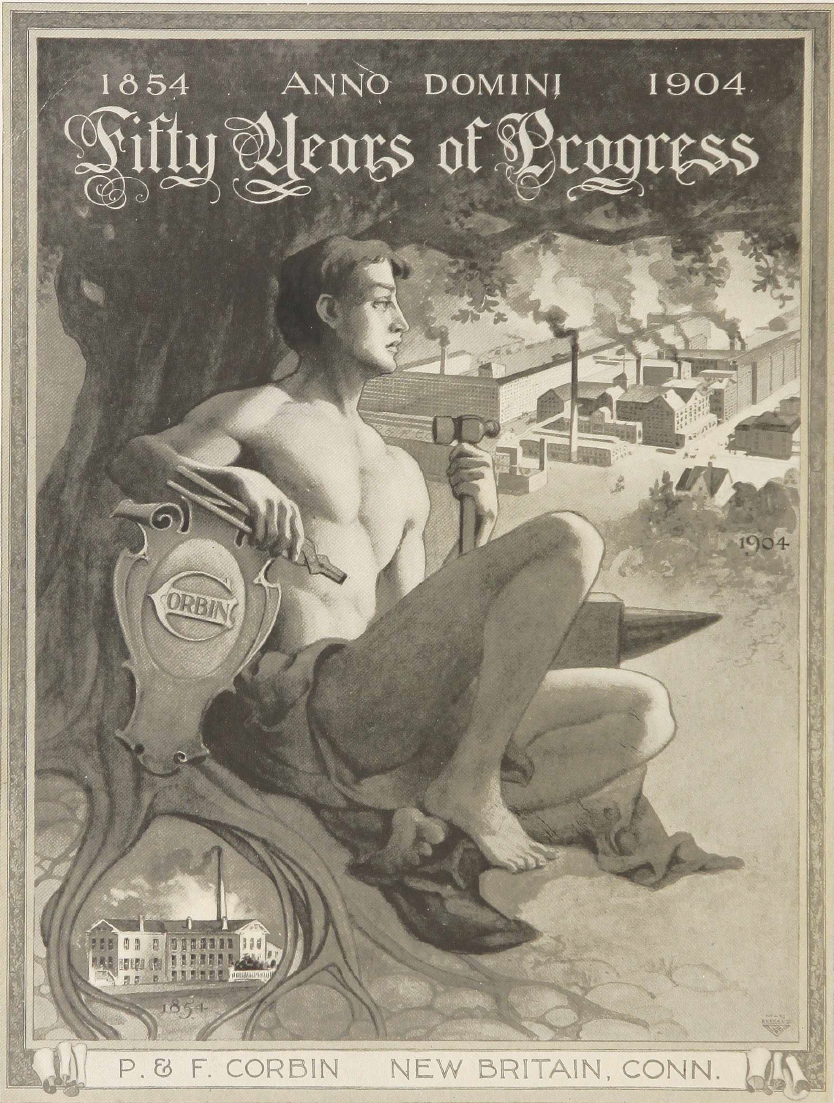
Note: The following is a republished excerpt from P. & F. Corbin’s History of the House of P. & F. Corbin. Published in 1904, it recounts the companies’ history on it’s 50th anniversary. We have made no changes to this excerpt and what you see is exactly how it was printed in 1904, albeit in a different medium.
History of the House of P. & F. Corbin
Illustrated: Including portraits of men notably identified with the growth of the house.
Issued in commemoration of the fiftieth anniversary of the founding of the house on the fourteenth day of February in the year eighteen hundred and fifty-four.
Author’s Preface
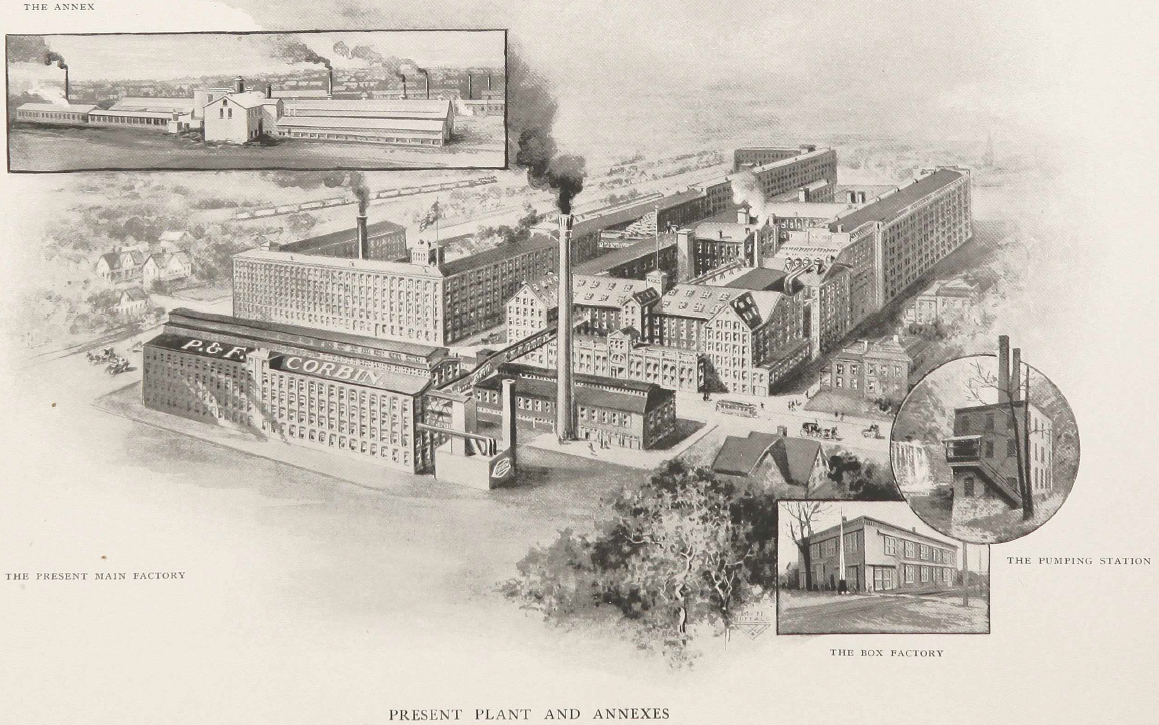
The visible exponents of a commercial institution like that of P. & F. Corbin are the men who conduct it, the buildings that afford it a home, and the goods which it produces and which furnish the reason for its existence.
Its history naturally consists in the relation of the events in which these factors appear conjointly and the circumstances which affect them. It is this which the follow pages attempt to set forth.
In writing the story the greatest difficulty has been to obey the injury to keep the background the personality of the men who have made the business. I have done all that I could in this direction, even to the extent of suppressing some occurrences that have had an important bearing upon the prosperity of the company and of minimizing the part in its growth and development taken by one or two of the persons who are still actively engaged in its affairs.
Yet, I trust that those who read can find between the lines that which I have not been permitted to write, and will be able to clothe the plain recital of facts and description of goods with somewhat of the living forces and personalities that have made the narrative possible.
-J. B. Comstock
Prologue
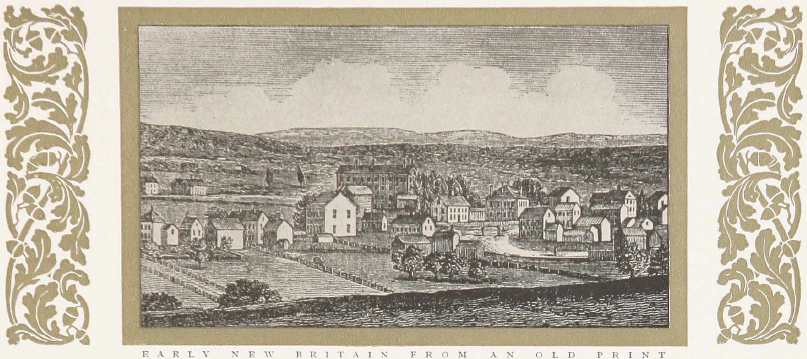
New Britain, Connecticut, known as “The Hardware City,” where the factories and general offices of P. &. F. Corbin are located, was originally part of the town of Farmington. In 1705, its people ceased to go there for worship, a new society having been formed nearer to it called the Great Swamp Society. In 1754, it grained a church of its own. In 1785, it severed its civil connection with Farmington and formed a part of the town of Berlin, incorporated at that time. In 1850, the town and borough of New Britain were incorporated. In 1870, the city was incorporated, and in 1900 it stood, on the census list, the 125th in size in the country. In 1754, it’s total population was about 300; in 1800, 946, in 1810, 982, in 1820, 1,000; in 1850, 3,029; in 1860, 5,385, in 1880, 13,977; in 1889, 18,500; in 1900, 28,202. To-day there are about 38,000 people within the city limits and supported by its industries, the growth of which may be fairly measured by the increase in the number of the city’s inhabitants.
In 1849, at the time of the history of P. &. F. Corbin begins, New Britain contained less than 3,000 inhabitants and the character of the town as a manufacturing center was fairly welly outlined. When the tax assessment list was made out in 1851 there were sixty-eight mercantile firms, mostly manufacturers, of which twenty-three were assessed as having invested two thousand dollars or more. There was always a rivalry between the concerns whose businesses were in any degree similar, which increased with the passage of years, and if it at times caused no small amount of bitterness it had a reflex action for good in that it kept all concerned keenly alive to the necessity of embracing every opportunity for improvement in goods and methods. As new comers, P. & F. Corbin had the greatest amount of opposition to overcome, and the lives of those who carried the burden in the early days were made the sterner and straiter, and each departure was probably more carefully considered and more thoroughly developed than would otherwise have been the case – and the foundation of the present business was, consequently, all the more firmly and surely laid.
The enterprises were small, as we should now consider them. The heads of the houses took off their coats and lent a hand wherever it was needed. The doors of the factories were as open to all comers as the door to the blacksmith’s shop to-day. Life was less complex and if interests were less divided they were pursued with a greater intensity of purpose.