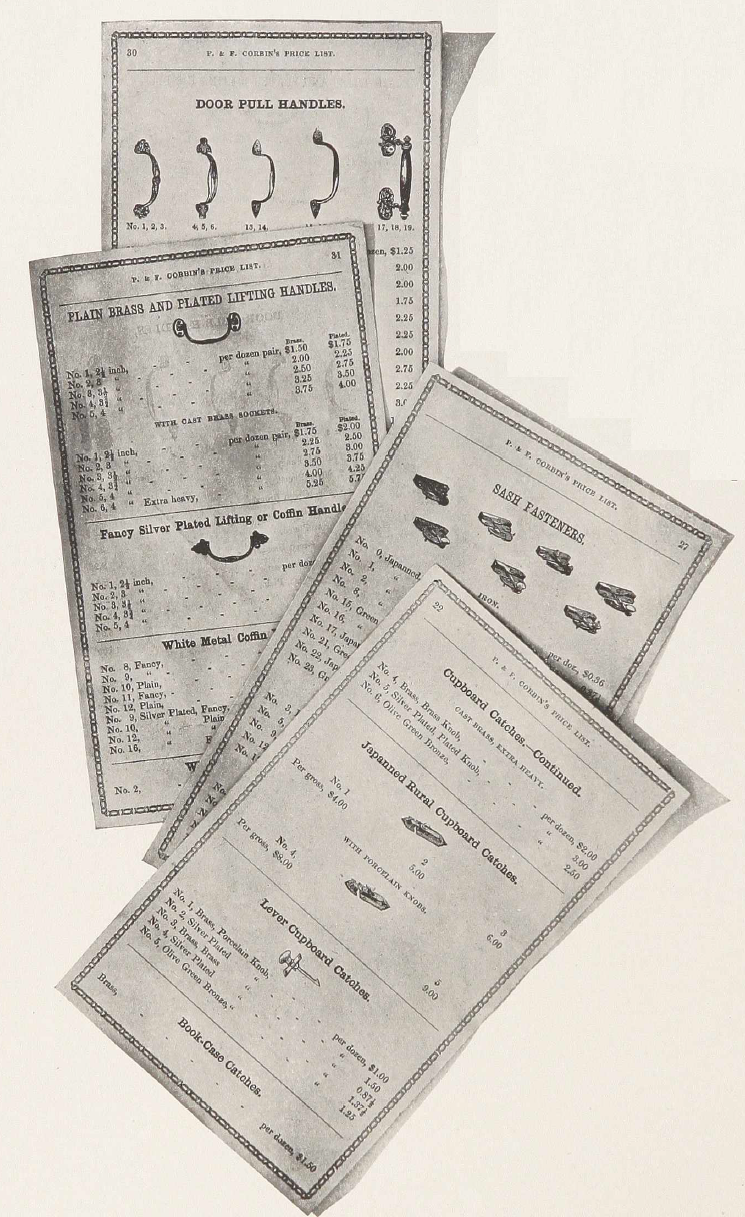
Note: The following is a republished excerpt from P. & F. Corbin’s History of the House of P. & F. Corbin. Published in 1904, it recounts the companies’ history on it’s 50th anniversary. We have made no changes to this excerpt and what you see is exactly how it was printed in 1904, albeit in a different medium.
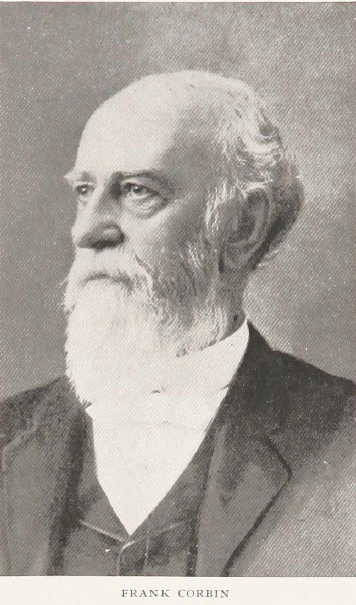
Doen, Corbin & Company (1849)
In the summer of 1848, Philip Corbin had fully determined that he must find employment elsewhere, and he and his brother Frank, after canvassing the matter fully, took into their counsel a brass founder by the name of Edward Doen, a good workman, and skilled in all branches of his trade. After much planning it was decided to a form a copartnership under the above caption and go into business for themselves. Each of the three men could furnish three hundred dollars, making a joint capital of nine hundred dollars, barely sufficient to equip a small – a very small – shop.
Land was procured in the eastern part of the town from Mr. Samuel Kelsey (a grandfather of Mrs. Philip Corbin and universally known as “Squire” Kelsey, and a contract was made with Mr. Henry W. Whiting for a two-story frame factory building, with stone foundation, and with a cellar extending under the entire building, the price for land and building being about six hundred dollars. In October, the cellar was dug and the wall was built, and Philip Corbin spent Thanksgiving Day in 1848 in banking the foundation to protect it from the winter frosts. In the following spring, the building was erected. A horse-power trade-mill which had seen some use had been contracted for in the fall before and was now installed in the cellar, and connected with the machinery, consisting of a grindstone, an emery wheel, and two lathes; a big black horse was bought to turn the machinery; two furnaces for casing (another was added a little later, when a small building was erected in the yard for a foundry) were built in the little lean-to in the rear, and by May of 1849 the plant was ready for operations. Everything was paid for in cash, and the three partners stepped into their establishment with a factory free from incumbrance and a cash balance of somewhat less than two hundred dollars – with which to buy metal and conduct the business.
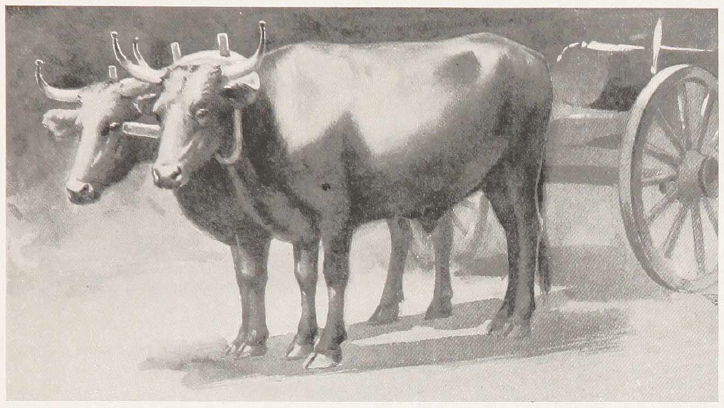
It was very evident that money must come in quickly if the new concern was to keep afloat, and to do this goods must be marketed as soon as possible. Ox balls for tipping the horns of cattle were in demand, and the partners had invented a new pattern or style which was an improvement on anything then made. A hardware merchant from an Ohio town, who was visiting a friend in Farmington, was shown one of these and at once gave a good order for them. July 4, 1849, was celebrated by Doen, Corbin & Co. by the shipment of their first bill of goods, completing the Ohio merchant’s order, amounting to between two and three hundred dollars.
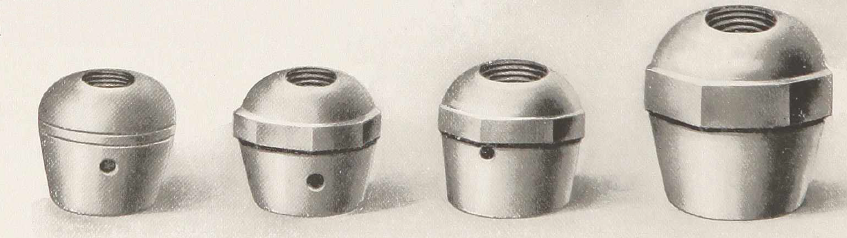
Ox Balls
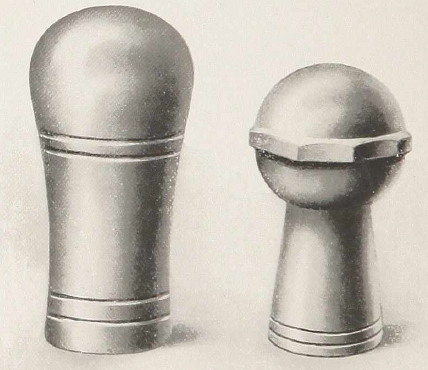
Ox Balls
When the new factory was ready to begin business, on the first of May in 1849, Mr. Philip Corbin had in his personal funds just eighteen dollars. This he put in the little drawer on the top of the bureau, locked it, hung the key on the standard at one side of the mirror, and told his wife that that was all the money he had; that he did not want to draw any money out of the business so long as it could be avoided, and that they would see how far the amount on hand could be made to go. It lasted for twenty months, during which time Mrs. Corbin with her own hands earned one hundred dollars packing goods in the shop, which went towards paying the general living expenses. They had no rent to pay; both of the young people had sufficient good clothing from their wedding outfits, and the money paid by two boarders supplied the table, with the aid of a garden, a cow, chickens, and a pig. For pleasure they had their companionship with each other and their friends and their interest in the business. They were well, and their simple, steadfast lives kept them so, and the hopes for the future, now so abundantly realized, meant more to them than any of the annoyances of the present – if indeed they gave them any consideration or suffered them to have any weight.
 The three partners worked hard. Mr. Doen was an excellent and accurate workman, but not especially rapid in his movements, so the two brothers did most of the productive work, leaving the other work for him. Philip Corbin, used to the long hours of a farm day, was wont to begin work at daylight or before – often as early as three o’clock – and by the time his helpers were ready for the day he had accomplished a goodly amount of work and had matters in shape for them to begin. A man named Samuel Goodrich was their first employee, and two boys were hired later to help in the foundry.
At the end of four months Mr. Doen grew dissatisfied. Illy-advised people persuaded him that without an engine to drive the machinery there was little chance of success. The disinclination of the Corbin brothers to assume a debt of six hundred dollars for a portable Baxter engine (which was in those days considered with favor and was a pioneer in its field) was the rock upon which the partnership split, and on September 1, 1849, Edward Doen sold his interest to Mr. Whiting, Mrs. Corbin’s father, receiving in payment his three hundred dollars, with six per cent. interest for the time invested, and $1.50 per day for his time. This was good wages in those days.
At the prices for labor which formed the basis upon which the cost of the goods was figured, an ordinary brass founder could make $1.50 per day, and a very good man could make $2.00. Philip Corbin, however, by hiring two boys to help him at a wage of 75 cents per day and working both late and early, was able to turn out work which, after paying the boys, would amount to from six to seven dollars per day for his own labor. To him, also, fell the correspondence, the collections and care of accounts and the keeping of the ledger, his brother Frank being chiefly employed in the production of goods.