
Note: The following is a republished excerpt from P. & F. Corbin’s History of the House of P. & F. Corbin. Published in 1904, it recounts the companies’ history on it’s 50th anniversary. We have made no changes to this excerpt and what you see is exactly how it was printed in 1904, albeit in a different medium.
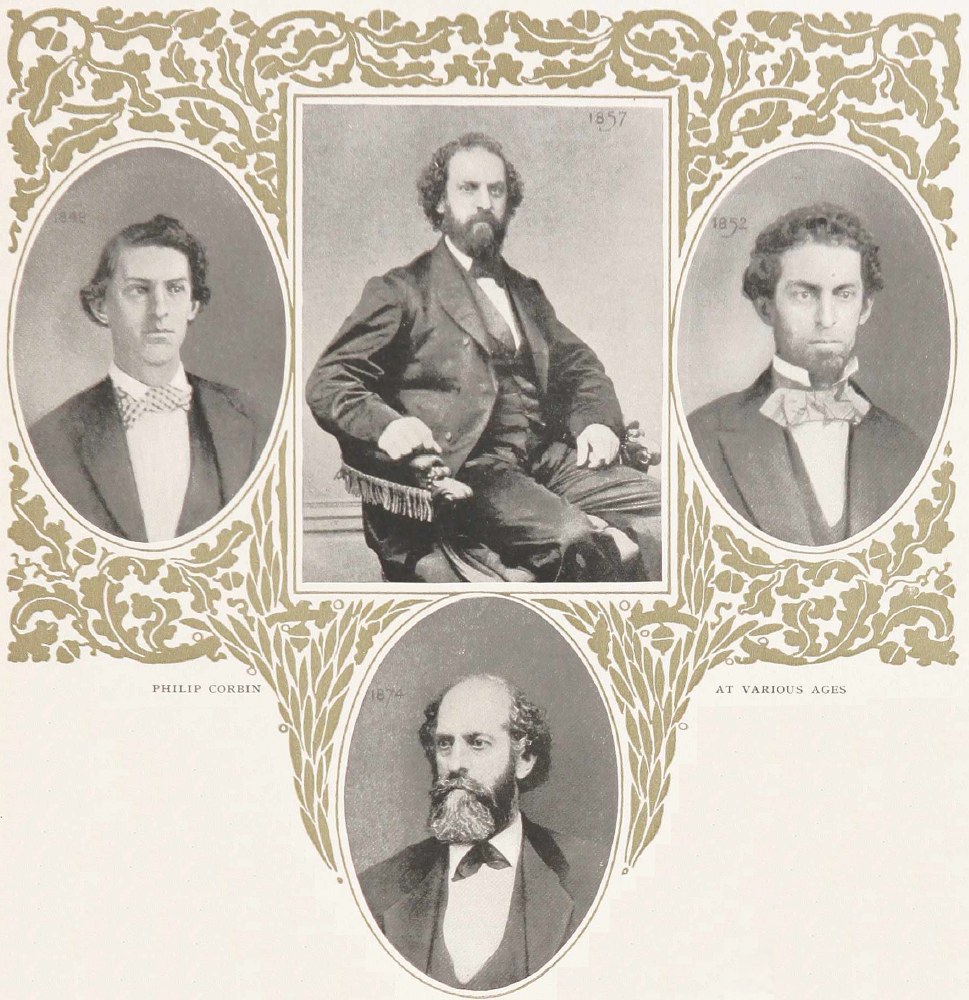
The Founder and Head of the House of Corbin
Hon. Philip Corbin, the founder of the commercial house of Corbin and its active manager and head from the inception to the present time, was born at Willington, Conn., on October 26, 1824, and spent there the first seven years of his life. The family is an old one, tracing the line back to Robert Corbin of Normandy. An ancestor, Geofrey Corbin, 1194, is mentioned in English history as is his descendant, Walter Corbin, 1272. In the American branch, the line traces back to the Clement Corbin or Corbyn of Roxbury, Mass.; to his son John Corbin, who rendered valuable service in King Philip’s war in 1675; to his son James, born in Roxbury in 1667, and one of the proprietors and original settlers of Woodstock in 1686; to his son Lemuel, born at Woodstock and afterwards a resident of Dudley, where he was tithing man in 1739, and constable in 1746; to his son Philip, a man of power and prominent citizen of Dudley, being made successively constable, captain, selectman, and representative; to his son Philip, Junior, born at Union and afterward a resident of Willington, where his son Philip, the third of the name in direct succession and the found of the Corbin industries, was born. He was the third of ten children, eight of whom were boys.
It is worthy of note that from the earliest known records of the family it has contained men of character, setting their impress upon the time in which they lived and leaving records of public and private service in the archives of church and state. Forceful, energetic, masterful, many of them of more than ordinary physical and mental ability, they transmitted their family characteristics to their descendants as the histories of their lives testified. Philip Corbin was thus born with a measure of physical strength and endurance which have ably aided him in his work. The fact that he was forced by the stress of circumstances to learn to employ his powers and sense of responsibility to their full capacity when young gives a still further explanation of his successful career.
When Philip was seven years old, the family moved to Farmington, near the Unionville line, the school to which the children were sent being in the latter town. Here they lived for a year; then for six years on a farm in West Hartford, whence they went to Ellington. A year later they returned to West Hartford to the old homestead, now known as Corbin’s Corners, still in the possession of the family, where Philip’s father died, July 24, 1881, and where his two sisters now reside.
When the family for the second time moved to West Hartford, Philip was a strong lad of fifteen, able to do a man’s work, and from this time until he reached the age of nineteen the most of his time was spent in farm work away from home, his wages being paid to his father, as was then the general custom with minors.
In addition to the education received at the district school, he had the benefit of a term and a half at the West Hartford academy. Considering his advantages, he was well informed. Indeed, at one time in this period, he had agreed to teach a school in the Stanley Quarter of New Britain, for ten dollars per month, but Augustus Stanley induced his kinsman, Noah Stanley, the selectman who had the matter in charge, to give the school to a distant relative named Carter, who offered to do the work for two dollars per month less. In the autumn of the same year his father contracted to cut one hundred and fifty cords of wood, relying upon four of the boys, Philip, Frank, Waldo, and Hezekiah, to do the work. In farm work, as in most other branches of industry, there is a pace maker or leader wherever there is a number of workers, the man who has the most energy or the greatest sense of responsibility assuming the place by natural selection. In this instance it was Philip who set the pace and, as is usual with leaders, performed the greatest portion of work. Axes are heavy in boyish hands, and it is easy to let an ambitious worker have a clear field for his efforts. It was Philip who finished the job alone. At the time, at the age of nineteen, he cut two cords of two food wood for a day’s work, receiving therefor forty-five cents per cord.

A man named Rowley passed the house one day while Philip was at work in the yard and strongly advised him to follow his example and secure a place in one of the New Britain hardware factories, saying that he could earn more money. The idea appeared to the young man to be a good one, and the longer he pondered upon it the better it seemed. It did not, however, meet with the same favor from his father, who refused to give it any consideration, saying that he had made arrangements for Philip to work for a farmer, a Mr. Elmer, at fifteen dollars per month, to lead his men. The leader of a gang of men ruled by example, and to hold his position must keep well ahead of his fellows – a task that might well dismay a boy of nineteen expected to outstrip six or seven men older than he and eager for the prestige to be gained by beating the leader. The father was anxious that Philip should take the place, for the wages were higher than those paid the regular farm hand, who got about twelve dollars per month, but Philip, fired by his new ambition and unwilling to assume the work which he felt was too hard for him, insisted so strongly upon having his way that the father finally gave a reluctant consent; and Philip went to New Britain to make a trial at the new work.
On the 18th of March, 1844, Philip Corbin began work in the shops of Matteson, Russell & Co. (afterwards Russell & Erwin), for a contractor by the name of Charles Burt, receiving fourteen dollars per month, out of which he must pay his board, and send the balance to aid in the support of the family. To add to his earnings he did whatever work he could find to do outside of the regular hours of labor; among other things, sweeping out the entire factory once a week for fifty cents. Mr. Burt released him for half a day each week in order to do the sweeping, and Philip out in more than enough overtime to offset the hours thus lost from his regular duties.
Three of the boys, Hezekiah, Waldo, and Frank, followed Philip’s example, and secured work in the New Britain shops, but in the following July the boys were called home to do the haying. So eager were they to get the work done and to earn money in order that they might continue in their new work, that they put in every moment of daylight in the hay field and finished in two weeks what ordinarily required twice as long. For the remainder of the season, some eight weeks, Philip worked for other farmers, receiving $1.50 per day, and thus giving his father as much money as though he had continued in farm work; consequently, there as no serious objection when he went back to his work in New Britain.
In the fall of 1844, therefore, Philip Corbin returned to New Britain and went to work for Henry Andrews, who had a contract to make locks for North & Stanley, receiving nineteen dollars per month for his services. At this time his knowledge of lock making was slight, and his work for Mr. Andrews upon locks was of a general character, requiring no particular skill; but the same spirit that had made him sought as a leader among the men on the farms caused him to desire to excel in his new field, and he improved such opportunities as were presented for the art of lock making as then practiced. There were in those days no cast locks, these articles being made throughout of wrought metal, and very largely by hand, the use of machinery being then but imperfectly developed. To make a lock required the deft use of hand tools, some natural ability and a much more thorough knowledge of locking mechanism than is required by the ordinary lock-fitter of to-day, and to become a good lock maker was to be a skilled workman – a leader among his fellows.

In the North & Stanley shops there was a lock contractor by the name of Bucknell, who was in the habit of working in the evening, getting every thing ready for his men to begin the morning without loss of time. Philip Corbin, anxious to learn, frequently spent the evening in the old gentleman’s department, helping him in his work. Mr. Bucknell, finding Philip’s services of value, offered to pay him for what he did, but Philip declined to take money, saying that if he could learn to make locks he would feel repaid. Finding him thus eager to learn, Mr. Buckneel took pains to teach him, and in sixty days he not only could make a good lock, but in his association with Mr. Bucknell had undoubtedly unconsciously absorbed a knowledge of the management of the workmen necessary to produce the best results.
By this time, the season for the letting of new contracts was near at hand and Mr. Buckneel suggested that Philip make a bid and endeavor to secure a contract for himself. To this Philip objected, saying that North & Stanley knew nothing about his ability as a lock maker and would not give a contract to him, a “green country boy,” as he put it.
“Put in your bid,” said Mr. Bucknell, “and when they come to you just refer them to me.”
So it was decided that Philip should enter a bid for a contract to make plate locks, a lock set into a wooden case or back cut out to receive it. One the morning the bids were opened, Mr. Henry Stanley entered the shop and approaching Philip, whom he only knew as a workman in his establishment, said “You man, what do you know about lock making?” “Ask Mr. Bucknell,” was Philip’s reply.
Mr. Bucknell’s report was so satisfactory that Philip Corbin was awarded the contract and began his career as a lock maker and employer of labor. It was unprecedented for a young man of twenty to hold such a place, but the work was done so satisfactorily that the contract was awarded him year without any question being raised regarding his ability to fulfill it.
At this time, Philip’s brother, Frank, then seventeen years of age, came to New Britain and was received into partnership on the second contract. The two brothers continued in partnership, working under a contract for North & Stanley until May 8, 1949. Until he attained his majority, Philip sent hom all his earnings except the portion required for his support, the amount being considerably in excess of anything that could have been realized as a farm hand. In the last year of his minority he gave his father fully a thousand dollars, a larger sum than the figures would represent to-day. Before he was twenty-one years old he had nineteen men in his employ and at the close of his last contract his force had grown to thirty or thirty-five.
The North & Stanley shop was operated by power derived from a brook running through the town not far from the present Corbin factories, all trace of which has entirely disappeared. In dry seasons the water failed to turn the machinery; in freshets or times of plentiful rain there was more power than was needed, and at such times it was customary to crowd the work to the fullest extent. The work which took the greatest amount of power was grinding off on emery wheels the protruding ends of the strips of iron which formed the two sides of the locks, and in the times when there was plenty of water this work was urged as much as possible. The Mr. Bucknell who gave Philip Corbin encouragement to take his first contract was now an old man, and finally had let his men go, being content to turn out only such locks as he himself could make. During one dry spell he had accumulated a large number of locks, the cases of which needed grinding, and when the succeeding heavy rains came, with the necessity for taking prompt advantage of the power, he had more grinding to do than he could accomplish. Philip, without knowing the old gentleman’s quandary, quietly set a number of wheels one afternoon and by working nearly all of that night finished the entire lot. When Mr. Bucknell came in the next morning he found the work done, much to his surprise and gratification, which was in nowise lessened when he learned that it was done without charge, as an expression of appreciation of past kindnesses, which Philip had thus endeavored to repay.
Philip Corbin’s interest in the welfare of his employers did not stop with the limits of his contract, and he was sorely tried by what seemed to him the failure to take advantage of opportunities for improvement. North & Stanley had a pattern maker named Cook, whose work was of an inferior order; the local competitor had a fine pattern maker whose name was Pye, and whose work excited Philip Corbin’s admiration. he found that Pye could be induced to transfer his services to North & Stanley and strongly urged Mr. Stanley to hire him, making some very severe criticisms of Cook’s work to support his argument, one being that he “could mold a cat in the sand and draw her by the tail and make a better casting than he could with Cook’s patterns.” This was repeated to Cook and caused a coolness that was unpleasant, since Cook worked at the bench next to him.
At another time, he strongly advocated the purchase of an improved key machine, pressing the matter so vigorously as to draw forth a severe rebuff; and awakening him to the fact that no reform or material improvement was possible under the prevailing conditions, he at once began to plan for a change that would give him a larger measure of freedom in the executions of his ideas, and the inauguration of a new business under his own management was the logical result.
In June of 1848, he disposed of an undivided one-half interest in whatever good and evil the future might hold for him by marrying Francina T. Whiting. She, like her husband, had been reared upon a good farm and had the thorough domestic training such as home gives. The two young people faced together the trials and problems attending the starting of a new business and to her courage and devotion, her assistance and support, Mr. Corbin ascribes much of the success of the enterprise in its formative period.
The history of Philip Corbin’s life from this time on is practically that of P. &. F. Corbin. Throughout it’s entire existence he has had the active management of its affairs, just as he has it to-day. He has followed in his career the principle of placing P. & F. Corbin’s interests above others that might conflict with them, and the position which the house of Corbin has attained in its field is a testimonial of his business judgment and sagacity, and of what may be achieved by a half century of advancement with a consistent, persistent, and unchanging policy under the direction of one man.
Mr. Corbin has other interests which he has assumed from time to time, when his doing so would not interfere with the demands made upon him by P. & F. Corbin. A list of the offices he occupies will be demonstrate the variety and scope of his activities. He is president of P. & F. Corbin, the American Hardware Corporation, the Corbin Cabinet Lock Company, the New Britain Machine Company, and the Porter & Dyson Company, all of New Britain; vice-president of the New Britain Savings Bank; a director of the Hartford National Bank of Hartford, Conn., the Mechanics National Bank of New Britain, and the Hartford Steam Boiler Inspection & Insurance Co. of Hartford. He has always been identified with church work, and for a number of years has been chairman of the Society’s Committee of the South Congregational Church of New Britain. He is found identified with and giving cordial support to the various plans for advancing the welfare of the community morally, socially, politically, and commercially.
A Whig in early life, he identified himself with the Republican party upon its organization, and has always taken a keen interest in civic affairs. He served as warden of the borough before the incorporation of New Britain as a town; also as a member of the city council; subsequently, as water commissioner, and he surprised the enlargement of the system that has given the city it’s splendid water supply. He was elected to the state legislature in 1884, and in 1888 was made a member of the state senate.