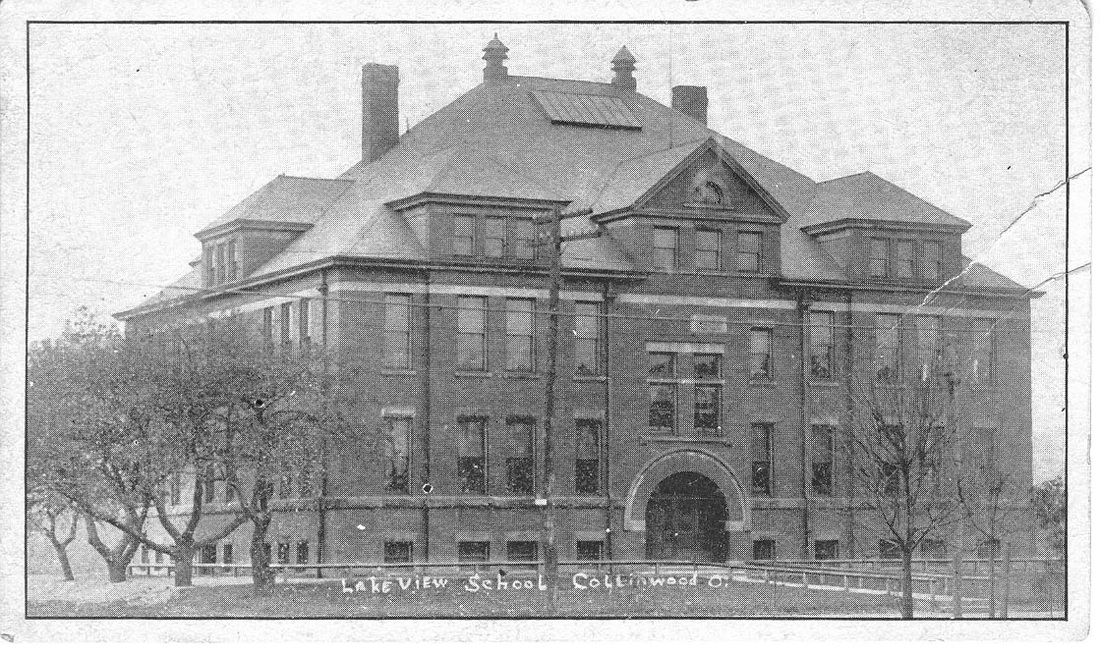
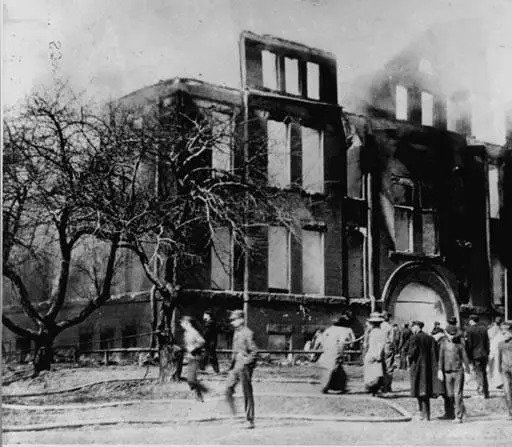
Lake View School on fire.
Author’s Note: The events we will be discussing occurred one-hundred-fifteen years ago. Many of the details have been lost to history. All attempts at accuracy have been made however, official records are often incomplete and media reports of the day are somewhat unreliable. A list of our source material will be provided at the end of this article.
The School Day Starts
Twenty-six-year-old Grace Fiske had entered the school well before her third grade students began arriving. Grace was born in New York, but later moved with her parents to Collinwood. Her father was a trimmer on a steam ship, and her mother was a housewife. Having become a teacher at age twenty-six is still not uncommon even today, nor is being unmarried and living with your parents. The house at 10522 Orville Avenue was only a few blocks away from the school so the daily walk was easy.
As her students began arriving a little after eight o’clock, there were the usual greetings and grumblings from students as they put away their coats and got their books, papers, and pencils ready. With forty-nine students, the room was completely packed. Over-crowding was a serious issue at Lake View. As we discussed in part one, the significant increase in population in such a short time led to issues throughout the village. Every classroom in the entire building was packed full. Even the third floor gymnasium that had been converted into classrooms was full of students. On that day in March, three-hundred-fifty students packed into a building that had been designed for only about two hundred. This forced teachers and staff to crowd the desks together and cram the kids in tight. Children were typically less than an arms length away from another classmate. This over-crowding also forced architects to build in additional wardrobe spaces in the school during the 1906 expansion. As a result, wardrobe rooms were constructed around the stairways as well. Continue reading